The surface and panel sector is evolving fast — along axes of performance, hygiene, digitalization and sustainability as much as aesthetics. For architects, designers and project teams, here is an in-depth roundup — with industry sources and new product technologies — of what is setting the agenda in 2026.
Sustainability is now a precondition
Responsible-forestry credentials (FSC/PEFC), low-emission classes (E1/E0, no-added-formaldehyde) and Environmental Product Declarations (EPD) are increasingly requested in public and corporate projects. The key change is this: a “sustainable product” claim is now read through origin, emission class, chain certification and life-cycle documentation, not only through catalog language.
On the regulatory side, the headline is the EUDR (EU Deforestation Regulation): after the December 2025 simplification-and-postponement package, large/medium companies must comply by December 30, 2026 and micro/small enterprises by June 30, 2027. It requires origin (geolocation) data and a “deforestation-free” declaration for wood products — traceability is now a compliance duty, not a marketing line.
Anti-fingerprint, super-matte surfaces
One of the most notable surface technologies of 2026 is super-matte, anti-fingerprint laminate. These surfaces aim for low light reflectivity, a soft touch and fewer visible fingerprints. Matte, mark-hiding surfaces are spreading fast in kitchens, furniture and corporate interiors.
Related reading: Anti-Fingerprint and Super-Matte Laminate Surfaces: Why They Stand Out in 2026
Hygienic and antimicrobial surfaces
Healthcare, education and hospitality keep demanding non-porous, easy-to-disinfect, antimicrobial surfaces. Compact laminate’s non-porous body is a natural fit: it won’t hold liquids or microorganisms and resists hospital-grade cleaners.
Related reading: Antibacterial and Antimicrobial Surfaces: What Do They Add to Compact Laminate Projects?
HD digital print, large format and thinner laminates
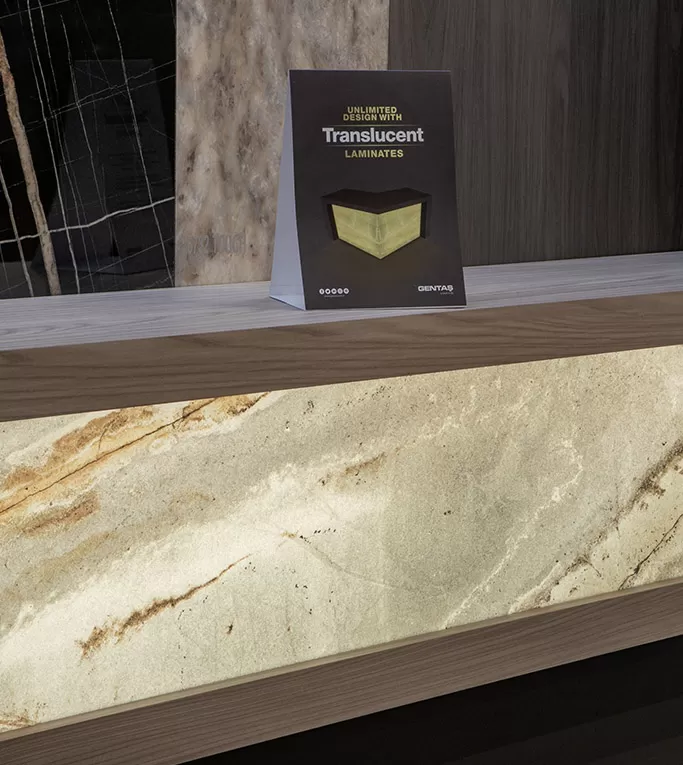
High-resolution digital print enables wood, stone, concrete and metallic textures plus project-specific patterns and short runs — “not in the catalog” is no longer a barrier. Two more trends stand out: large-format panels that cut installation time and cost, and thinner laminates for lighter constructions. Some makers are even trialing embedded “smart” functions such as wireless charging or LED backlighting in the surface.
Related reading: Custom Project Design with Digital-Print Laminate Surfaces
Mass-timber momentum and the compact panel
CLT and mass timber remain visible because of embodied-carbon and fast-installation discussions. WoodWorks covers mass timber in data-center and similar new building typologies in its 2026 agenda. This momentum makes timber-friendly, exterior-grade compact panels, especially in ventilated/rainscreen facades, a more visible part of architectural language.
Digitalization in supply and fabrication
Digitalization in panels is not only an online-sales topic. From project drawings to CNC cutting, batch tracking and technical document sharing, data quality matters more. In export-linked work, connecting product code, origin, certificate and datasheet to the same batch gives procurement teams a real advantage.
These trends in Gülmar Yapı products
The themes above map onto the current family via a broad decor collection, non-porous compact surfaces and exterior panels. Explore them on the products page, exterior solutions on the G-EXT page, and made-to-measure cutting via our CNC services.
Related guide: How to Specify Laboratory Worktops: An EN 14056-1:2025, EN 13150 and SEFA 3 Checklist
Sources
#wood trends
#sustainability
#antibacterial surface
#digital print decor
#EPD
#mass timber

 Panels & Plates
Manufacturer

 ®