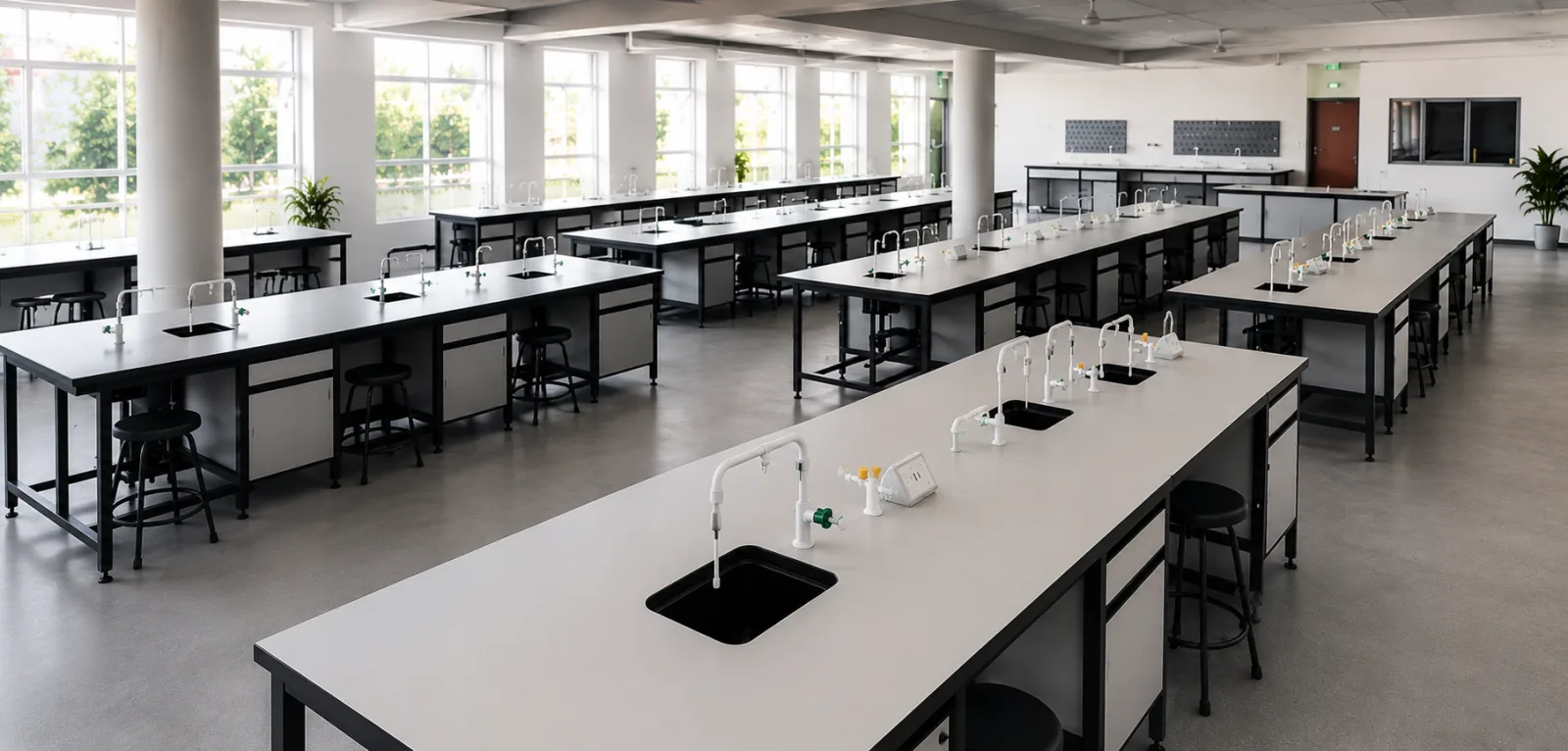
Short answer: A laboratory worktop specification should name the surface material (EN 438-4 compact laminate, often called “solid phenolic resin”), thickness and tolerance, the chemical-resistance test method and acceptance level (SEFA 3-2020), the fire class where required (EN 13501-1), seam and sink details, the furniture standard (EN 14056-1:2025, or EN 13150:2020 for schools) and required submittals.
Last updated: 2026-11 · Reflects EN 14056-1:2025.
Writing “chemical-resistant worktop” and nothing else lets very different products compete on the same bid line. This guide is about the procurement side rather than material selection: which standard covers what, how a real public tender describes the worktop, how to read a SEFA results table, and which clauses you can paste into your own spec. For a material-by-material comparison, see our chemical resistance guide.
Is a “phenolic resin worktop” the same as compact laminate?
For practical purposes, yes, and the cleanest spec names both. Compact laminate is defined in EN 438-4: a self-supporting, high-pressure laminate 2 mm thick or more, intended for interior use, with test methods set out in EN 438-2. In the classification used by ICDLI, the body representing European laminate manufacturers, “C” means compact, “G” general purpose, “S” standard and “F” flame-retardant grade. So CGS is standard compact and CGF is flame-retardant compact.
SEFA 3-2020 uses two separate definitions. A “solid phenolic composite” is a solid panel with a homogeneous core of organic-fiber-reinforced phenolic and non-porous surfaces. A “high pressure plastic laminate” is a thin sheet whose sanded back is bonded to a substrate. What specs call a “solid phenolic resin” top matches the first definition, which is compact laminate. To avoid confusion, write: “Self-supporting solid-core compact laminate (phenolic resin) worktop to EN 438-4.” That keeps thin HPL on particleboard or MDF off the same line item. Our compact laminate vs. HPL guide covers the difference in detail.
Which standards belong in a lab worktop specification?
No single standard describes a laboratory worktop. Furniture design, surface material and chemical performance sit in separate documents. The table shows what each one covers and how to cite it.
| Standard | Scope | How to cite it in the spec |
|---|
| EN 14056-1:2025 | Laboratory furniture, recommendations for design and installation, Part 1: General. Covers benches, storage units and service connections in research, analytical, process and higher-education labs; schools are excluded. Predecessor: EN 14056:2003. | “Benches, storage units and service connections shall be designed and installed to EN 14056-1:2025.” |
|---|
| EN 13150:2020 | Workbenches for laboratories in educational institutions: dimensions, safety, durability and test methods. Work-surface resistance, fire safety, electrical safety and media services are excluded. | “School lab benches shall comply with EN 13150:2020; the work surface is further specified to EN 438-4 and SEFA 3.” |
|---|
| EN 438-4 (methods: EN 438-2) | Classification and specifications for compact laminates 2 mm and thicker. | “EN 438-4 CGS (CGF where a fire class applies) compact laminate; values declared per EN 438-2 methods.” |
|---|
| SEFA 3-2020 | Laboratory work surfaces and sinks: chemical/stain resistance (Methods A/B, 24 hours, levels 0–3), heat, impact, load, water absorption and sink criteria. | “Laboratory-grade surface per SEFA 3-2020, with a report from a SEFA-approved independent lab.” |
|---|
| SEFA 2-2020 | Laboratory furniture installation standard; SEFA 3 refers to it for storage, handling and installation. | “Storage, handling and installation per SEFA 2-2020.” |
|---|
| SEFA 8 family | Lab-grade casework standards, split by material: metal (8-M), phenolic (8-PH), plastic laminate (8-PL), polypropylene (8-P) and wood (8-W). | If cabinets are also specified, cite the matching part, e.g. SEFA 8-PH for phenolic casework. |
|---|
| EN 13501-1 | Reaction-to-fire classification of construction products. | “Where a fire requirement applies, the target class (e.g. B-s2,d0) and a classification report shall be provided.” |
|---|
The detail that trips people up: EN 13150:2020 explicitly leaves work-surface resistance and fire safety out of scope. A school spec that only says “to EN 13150” leaves the chemical and fire performance of the top undefined. EN 14056-1:2025, meanwhile, does not cover schools at all; it targets research, analytical, process and higher-education laboratories.
How does a real public tender describe the worktop? (2026 example)
A useful reference is “Annex 2, Laboratory Equipment Specification” from the 2026 tender by Türkiye’s Ministry of Agriculture and Forestry for BSL-2 and BSL-3 laboratories at its veterinary control institutes in Istanbul (Pendik), Izmir (Bornova) and Konya. The worktop requirements include:
- Countertops 20 mm and splashbacks 6 mm, in “laboratory-grade solid-core phenolic resin.”
- Worktop depths coded as 600, 750 and 900 mm; the modular frame example is 880 mm high and 690 mm deep.
- All worktop joints sealed with an elastic sealant. The document names a product but adds “or similar,” and requires joints and edges to be smooth and flush.
- No wood substructure under stainless steel or other worktops.
- Minimum technical and chemical-resistance values defined on a separate data sheet.
That approach matches Article 12 of Türkiye’s Public Procurement Law No. 4734: technical specifications may not name a particular brand, model or product, and a brand may be mentioned only with the words “or equivalent” when no standard exists or the technical features cannot otherwise be described. Writing standards and measurable values instead of brand names keeps competition open and makes bids comparable, wherever you are buying.
How do you read a SEFA results table?
SEFA 3-2020 runs the chemical spot test two ways. Method A is for volatile chemicals (organic solvents): a cotton ball saturated with the chemical sits on the surface under an inverted small container for 24 hours. Method B is for non-volatile chemicals: 5 drops (about 1/4 cc) go on the surface under a 25 mm watch glass for 24 hours. Testing is done at 23 ± 2 °C; the area is then washed with water, detergent and isopropyl alcohol and rated.
The levels: 0 no effect; 1 slight change in color or gloss, no change in function; 2 clearly visible change in color or gloss, no significant loss of life or function; 3 objectionable change in appearance that may affect function over time. Under SEFA 3-2020, a “laboratory grade” surface may show no more than 4 Level 3 results across the 49 specified reagents, and testing must be done by a SEFA-approved independent lab.
Here is a summary of the results in Gentaş’s G-Lab technical datasheet:
| Result | Chemicals in the G-Lab datasheet | What it means |
|---|
| Level 0 | 44 of 53 test rows, e.g. acetone, methylene chloride, 37% hydrochloric acid, 70% nitric acid, 40% sodium hydroxide, 16% sodium hypochlorite, 30% hydrogen peroxide | No visible change |
|---|
| Level 1 | 28% ammonium hydroxide, 60% chromic acid, 1% methylene blue, 1% methyl violet 2B, 5% potassium permanganate, 33% and 96% sulfuric acid, 77% sulfuric + 70% nitric acid mix | Slight color/gloss change |
|---|
| Level 2 | Iodine tincture | Clearly visible stain |
|---|
| Level 3 | None | — |
|---|
| Disinfectants (5 agents) | 4 at Level 0; 0.5% N-(3-aminopropyl)-N-dodecylpropane-1,3-diamine at Level 1 | Surface resistance to hospital and lab disinfectants |
|---|
Two caveats. First, the datasheet reports results against SEFA 8-1999 (Ref. 2006) and SEFA 3-2010; if your spec calls for SEFA 3-2020 and an independent lab report, ask for that separately at bid stage. Second, SEFA 3 itself recommends that users test samples with their own chemicals in their actual environment, since concentration, time and temperature all change the outcome. For a chemical-group reading, see our chemical resistance guide; for hygiene, see hygienic compact surfaces for labs.
How should thickness, sinks, edges and splashbacks be specified?
Thickness: Choose it from the span, the support spacing and the equipment load. The public tender above calls for a 20 mm top and a 6 mm splashback. G-Lab is made from 0.80 to 22 mm, and for lab worktops we usually recommend 12–20 mm. Per the EN 438-4 requirements listed in the G-Lab datasheet, thickness tolerance is ±0.7 mm for 16–20 mm and ±0.8 mm for 20–25 mm, and flatness deviation for sheets 10 mm and thicker is no more than 3 mm per meter.
Sheet size and seams: G-Lab sheets come in 1400×3660, 1540×3050 and 1540×3660 mm. A straight run longer than 3.66 m needs a seam, so show it on the shop drawing and keep it away from the sink cutout.
Sinks: SEFA 3-2020 calls for a drain outlet of at least 1-1/2 in. (about 38 mm), an internal basin fall of at least 1°, and a load capacity of 1.5 times the weight of the water the sink can hold. Plug, strainer and overflow details belong in the spec too.
Edges and drip grooves: SEFA 3 leaves these to the manufacturer’s guidelines and suggests obtaining and approving samples before specifying. Write the edge profile (chamfer or radius), the drip groove and a sample-approval step into the spec. Our CNC measurement, hole and edge guide covers cutting tolerances.
Heat: SEFA 3 tells users to consult the manufacturer about hot crucibles and Bunsen burners. The G-Lab datasheet reports a 180 °C dry heat test per EN 438-2; even so, a clause requiring heat-resistant pads for hot vessels and open flames is good practice.
Copy-ready specification clauses
These clauses are brand-neutral; adjust the values to your project.
- Material: Work surface shall be self-supporting, solid-core compact laminate (phenolic resin) to EN 438-4, grade CGS. Where a fire requirement applies, grade CGF and an EN 13501-1 classification report are required.
- Thickness: Worktop 20 mm, splashback 6 mm (adjust per project); thickness tolerance and flatness to EN 438-4.
- Density: Minimum 1.35 g/cm³ (ISO 1183-1).
- Chemical resistance: SEFA 3-2020 Methods A/B, 24-hour exposure; no more than 4 Level 3 results across the 49 specified reagents. Report from a SEFA-approved independent lab. Critical chemicals and disinfectants named by the owner shall also be tested on samples.
- Seams and joints: Worktop joints and splashback-to-top corners sealed with an elastic sealant whose compatibility with the lab’s chemicals is confirmed in writing by its manufacturer; joints and edges smooth and flush. Seam locations shown on shop drawings.
- Sinks: Drain outlet at least 38 mm (1-1/2 in.), basin fall at least 1°, load capacity 1.5 times the maximum water weight (SEFA 3-2020).
- Fabrication: Sink, faucet and outlet cutouts and drip grooves CNC-machined; edge profile and color subject to sample approval.
- Furniture standard: Benches, storage units and service connections designed to EN 14056-1:2025 (EN 13150:2020 for school labs); installation per SEFA 2-2020.
- Submittals: Technical datasheet, product-standard certificate of conformity, chemical-resistance test report and samples submitted with the bid. Where a brand must be named, add “or equivalent.”
Which certificates and datasheets should you ask for?
Ask for three documents with every bid: the product datasheet, a certificate of conformity to the product standard, and the chemical-resistance test report. As an example, Gentaş holds a TSE (Turkish Standards Institution) certificate for compact laminate (certificate no. 001451-TSE-05/05, registered trademark GETAKOMPAKT, TS EN 438-4) covering grades CGS and CGF at 2 mm and thicker, valid until September 24, 2027. Confirm in writing which product names the certificate covers, and check the record through the verification link printed on the certificate.
For fire-rated projects, also request an EN 13501-1 classification report. ICDLI’s HPL technical leaflet gives D-s2,d0 or better for CGS and B-s2,d0 or C-s2,d0 or better for CGF under EN 13501; the target class for your project should be backed by a product-specific report. More in our fire-retardant compact panel guide.
How we work at Gülmar
We have been based in Bornova, Izmir since 1998 and have been a Gentaş main dealer since 2020. On lab projects, we start from your spec and layout drawing, then agree on thickness, seam locations, and sink and faucet details with you. G-Lab chemical-resistant compact laminate sheets are CNC-cut to size, with sink openings, faucet and outlet holes, drip grooves and edge profiles machined in, and the tops are delivered ready to install. Typical CNC lead time is 7–10 days, and we have completed more than 1,200 projects. See our laboratory worktops page for product details and CNC services for cutting capacity. Send your spec on WhatsApp and we will quote against it clause by clause.
Sources
#laboratory worktop specification
#phenolic resin lab countertop specification
#compact laminate lab worktop
#lab countertop thickness
#SEFA 3
#SEFA 8
#EN 14056-1
#EN 13150
#G-Lab
 Panels & Plates
Manufacturer

 ®