Short answer: CDF board (compact density fiberboard) is a fiberboard with a density of 1,000 kg/m³ or more, a black, homogeneous fiber core through its full thickness and melamine on both faces. Its edges can stay unbanded. It is moisture-resistant but not waterproof: use it in dry and splash-zone interiors, and choose G-COM compact laminate for showers and pools.
Search for "CDF" and you will often find the cumulative distribution function from statistics. This article is about something else: CDF (compact density fiberboard) toilet cubicles, urinal partitions, changing cubicles and lockers. Below we cover the specs of our CDF board, how it differs from MDF and compact laminate, a wet-zone selection table, and what to watch for when a tender calls for compact laminate. The CDF values are our own technical data; external figures are cited in the sources list at the end.
What is CDF board, and what does the name mean?
CDF stands for compact density fiberboard. It is a wood-based fiberboard; "compact" refers to its high density. From the outside it looks a lot like compact laminate, because both have dark, solid-looking edges. But the raw material, the internal structure and the governing standard are different, and the tables below spell that out.
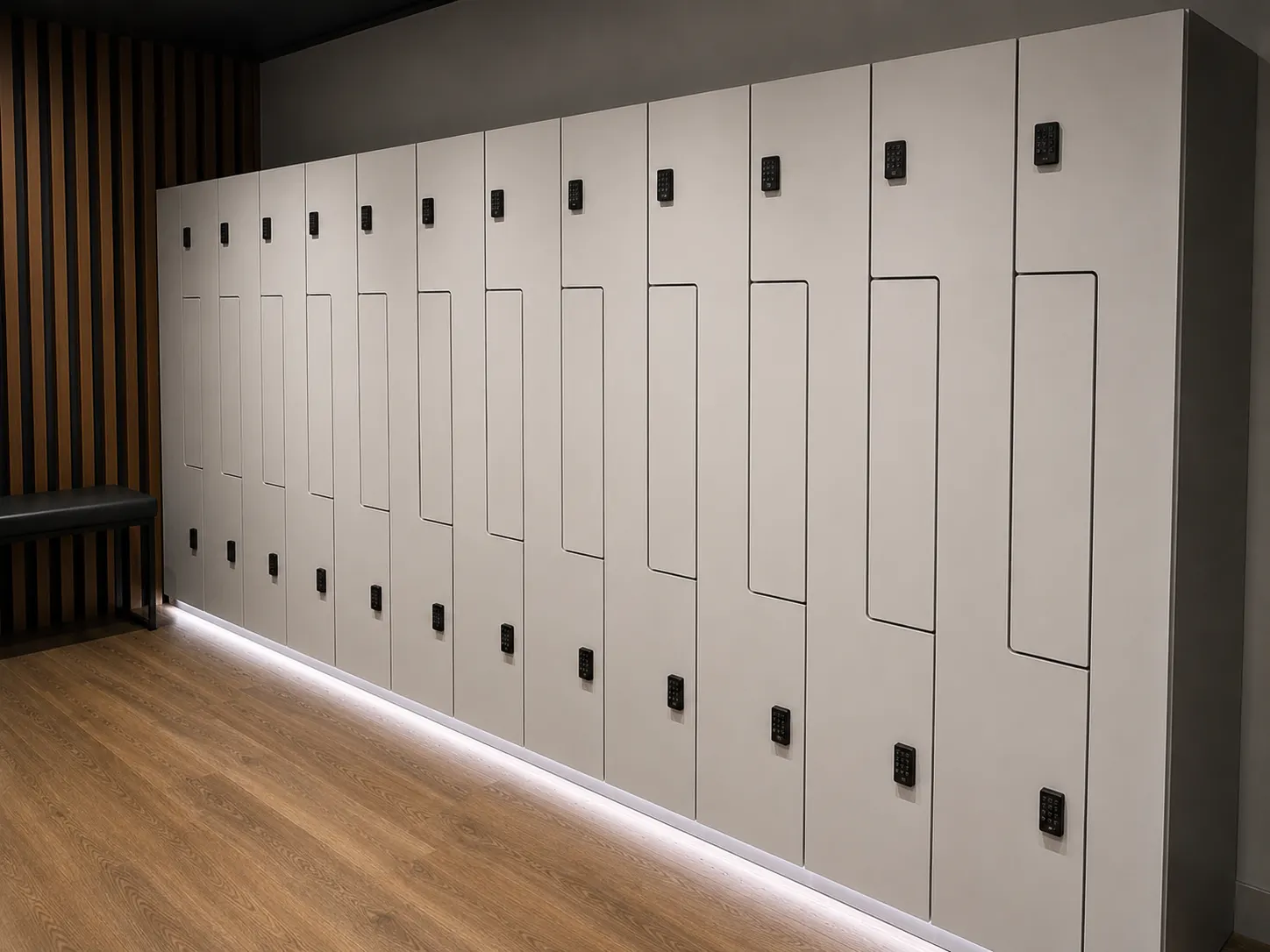
The feature people recognize first is the black core. Because the fibers are black and evenly distributed through the full thickness, CNC-machined edges, routed grooves and drilled holes can be left exposed without edge banding. On parts with lots of edges, such as cubicle doors and locker doors, that removes edge-banding labor altogether, and with it the risk of banding peeling off later.
What are the specs of our CDF board?
The values below are the technical data for our 12 mm CDF board. The weight row is a calculation (density × thickness), not a measurement; because density is given as a minimum, so is the weight.
| Property | Value | Note |
|---|
| Thickness | 12 mm | Single thickness |
|---|
| Sheet size | 1830×2440 mm and 2100×2440 mm | Two sizes |
|---|
| Density | ≥1,000 kg/m³ | High for a fiberboard |
|---|
| Core | Black, homogeneous fiber distribution | No edge banding needed |
|---|
| Surface | Melamine on both faces | Solid colors |
|---|
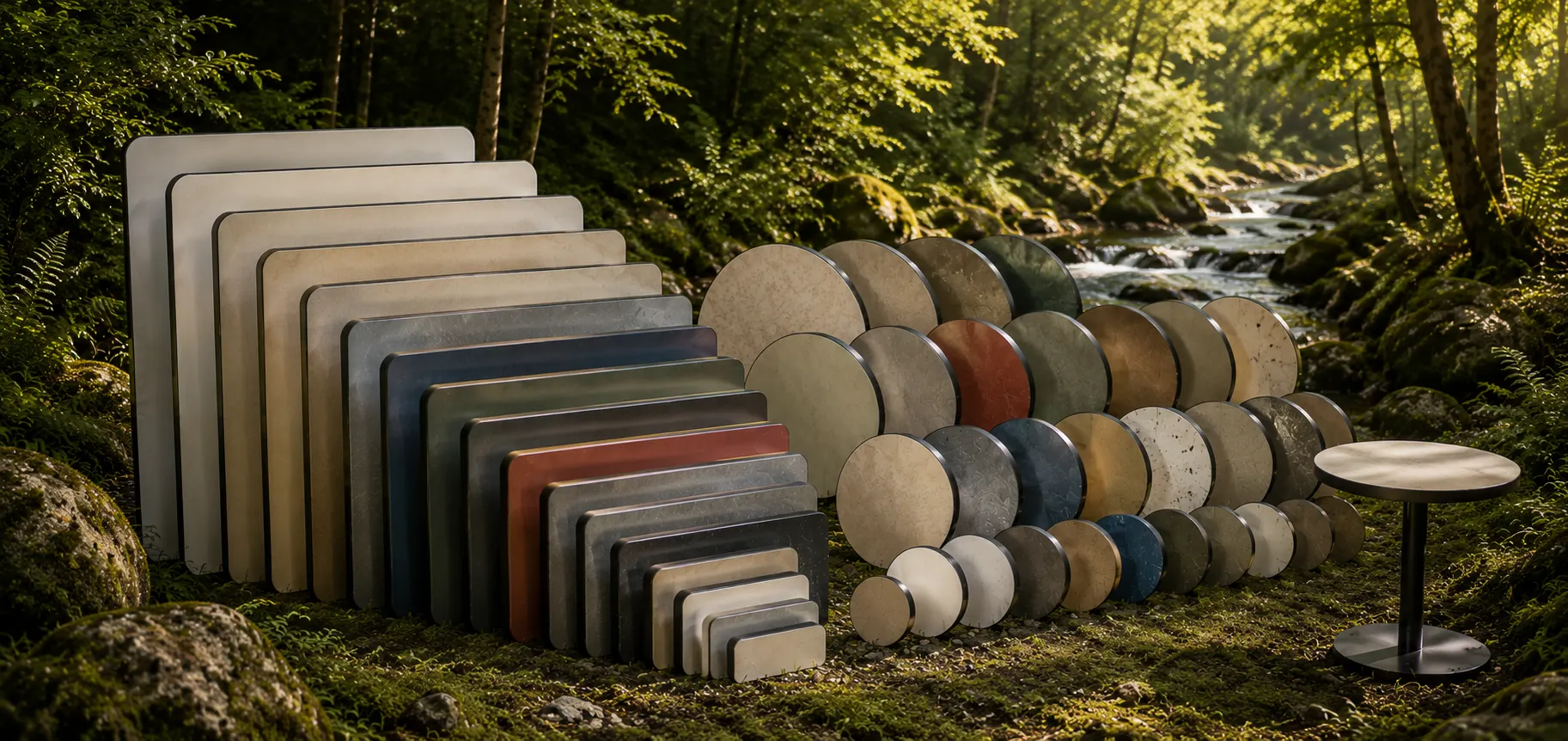
| Colors | White, Cream, Office Gray, Anthracite | Wider palette: G-COM |
|---|
| Emission class | E1 | See the 2026 EU note below |
|---|
| Water and moisture | Moisture-resistant, not waterproof | For areas without direct water exposure |
|---|
| Weight (calculated) | At least ≈12 kg/m² | Based on the minimum density; G-COM at the same thickness ≈16.8 kg/m² (at the measured 1.4 g/cm³) |
|---|
We do not estimate values that are not in this table (bending strength, thickness swelling, fire class, screw holding). If your specification requires them, we confirm them with documentation at the quotation stage. For color samples and application examples, see our CDF board and CDF toilet cubicles page.
How is CDF different from MDF?
CDF and MDF belong to the same family: both are boards made from wood fibers. The differences are density, what the core looks like, and what each board is meant for.
In Europe, MDF is specified by EN 622-5. The standard splits MDF into types by service condition, for example "MDF" for dry conditions and "MDF.H" for humid conditions. Under its definitions, dry conditions mean the relative humidity of the surrounding air exceeds 65% for only a few weeks a year; for humid conditions that threshold is 85%. In other words, even moisture-resistant MDF is defined for a humidity range, not for permanently wet areas.
How fiberboards react to water is measured with EN 317: a sample is immersed and its increase in thickness (swelling) is recorded. In a peer-reviewed 2020 study in Materials, 3 mm HDF panels with a density of 860 kg/m³, made with the industry-standard paraffin wax water repellent, swelled by about 23% in thickness after 24 hours. That figure is not for CDF. It does show that even high-density fiberboards can swell when they sit in water for a long time, and it is the technical reason we do not recommend CDF inside showers.
- Core: black and homogeneous in CDF. In MDF it is the natural fiber color, so exposed edges usually need banding or paint.
- Edges: CDF edges can stay unbanded. On MDF laminate panels, edge banding is the standard detail; more on that in where to use MDF laminate panels.
- Purpose: MDF is the general-purpose board for furniture and interior paneling. CDF targets heavily used cubicle and locker parts where the edge stays visible.
How is CDF different from compact laminate?
Compact laminate is made by pressing resin-impregnated paper layers under high pressure, and it is covered by EN 438-4. That standard sets performance requirements for compact laminates 2 mm thick or more, made by a high-pressure process for interior use. CDF is a fiberboard and falls outside the scope of EN 438-4.
| Criterion | CDF board | MDF | Compact laminate (G-COM) |
|---|
| Material | High-density fiberboard | Fiberboard | Resin-impregnated paper layers pressed under high pressure |
|---|
| Standard | Outside the scope of EN 438-4 | EN 622-5 (types such as MDF, MDF.H) | EN 438-4 (CGS) |
|---|
| Density | ≥1,000 kg/m³ | Varies by type and product | ≥1.35 g/cm³ (1.4 g/cm³ measured on the data sheet) |
|---|
| Edge | Black core, unbanded | Usually banded or painted | Solid compact edge, no banding needed |
|---|
| Response to water | Moisture-resistant, not waterproof | Depends on type; not defined for permanently wet areas | Boiling water immersion (≥5 mm): mass increase 0.55%, thickness increase 0.65% (limit 2%) |
|---|
| Fire class | Documented at quotation if specified | Varies by product | B-s1,d0 (12 mm ≤ thickness < 25 mm, EN 13501-1) |
|---|
| Emissions | E1 | Varies by product | E1 (EN 717-1) |
|---|
| Weight at 12 mm (calculated) | At least ≈12 kg/m² | Depends on density | ≈16.8 kg/m² |
|---|
G-COM values come from the Gentaş G-COM technical data sheet. The boiling water result (EN 438-2) and the HDF swelling figure above (EN 317) come from different test methods, so they are not directly comparable; the table only shows the order-of-magnitude difference in how these materials respond to water. We describe the surface of compact laminate as "water-resistant"; for CDF the accurate term is "moisture-resistant," and CDF is not waterproof. For a broader comparison, see compact laminate vs. HPL and the G-COM compact laminate page.
Which wet zone calls for CDF, and which for G-COM?
One question usually decides it: will the panel be in direct, prolonged contact with water? If yes, G-COM. If not, and the room is well ventilated, CDF.
| Wet zone | Typical rooms | Our recommendation | Watch for |
|---|
| Dry interior | Office and school restroom partitions, dry changing cubicles, lockers | CDF | Ventilate the room and locker interiors |
|---|
| Splash zone, well ventilated | Shopping mall and factory restrooms, raised urinal partitions | CDF (conditional) | Panels on legs clear of the floor; machined edges sealed |
|---|
| Floors hosed down or washed with plenty of water | High-traffic public restrooms | G-COM | Panel bottoms must stay clear of standing water |
|---|
| Direct, continuous water | Shower partitions, pool and spa changing areas, wet changing rooms | G-COM | CDF not recommended |
|---|
| Exterior | Facades, open-air areas | Not CDF | Use exterior-grade products such as G-EXT for facades |
|---|
For the other factors in wet-area material selection, see material selection in compact WC cubicle systems; for cubicle and door sizes, see toilet cubicle dimensions.
Can CDF be offered when a tender specifies "compact laminate (EN 438-4)"?
The technical answer is clear: CDF is outside the scope of EN 438-4, which describes compact laminates made by a high-pressure process. If a specification explicitly calls for "EN 438-4 compact laminate," CDF does not meet that description. Whether it can be accepted as an equivalent is up to the contracting authority. We do not give legal opinions on that, and we recommend asking the authority in writing before you bid.
On projects like these we quote G-COM. If the specification also requires a fire class, G-COM's B-s1,d0 classification for thicknesses from 12 mm up to (but not including) 25 mm is on its data sheet. For how fire classes are read, see what fire-retardant laminate and compact panel mean.
What do we build with CDF?
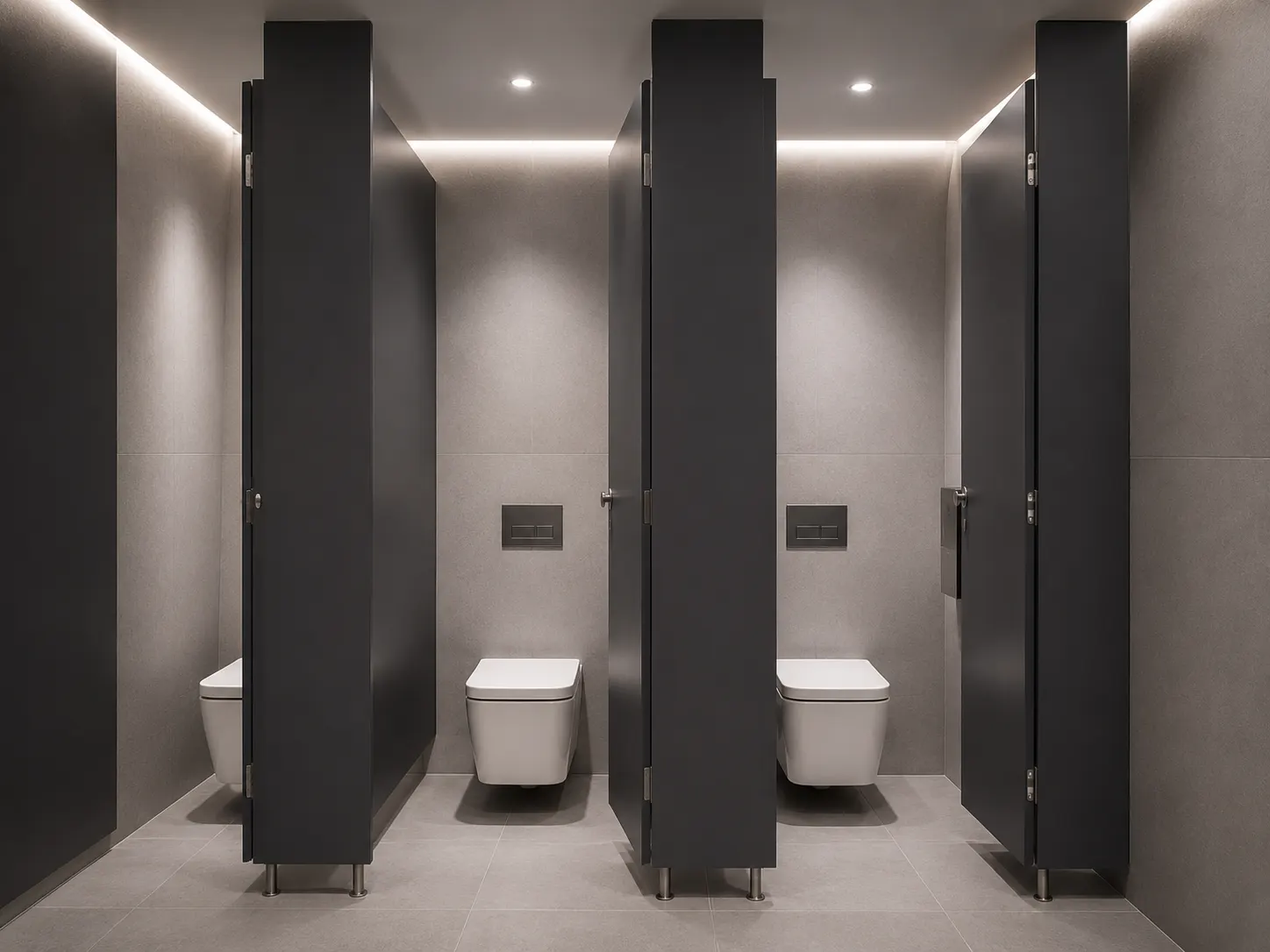
- Toilet cubicles: partitions and doors for restrooms in offices, schools, shopping malls, factories and warehouses.
- Urinal partitions: raised clear of the floor and kept away from direct water.
- Changing cubicles: in the dry changing areas of sports, commercial and cultural facilities.
- Lockers: carcasses and doors for gym, school and factory locker rooms.
If a project has both a dry section and showers, the two materials can work side by side: CDF in the dry section and compact laminate WC cubicles in the wet section.
How does a CDF project work with Gülmar?
We have worked with panel and surface materials in Bornova, Izmir since 1998, have been a Gentaş main dealer since 2020, and have completed more than 1,200 projects. We offer CDF at four levels, depending on what you need:
- Board: 12 mm, in 1830×2440 or 2100×2440 mm sheets.
- CNC cutting: cut-to-size parts, hinge and lock recesses, holes and edge machining. Typical lead time is 7–10 days, depending on project size. Details on our CNC services page.
- Hardware: hinges, locks, legs and connectors, in stainless steel or moisture-resistant options to suit the room.
- Installation: on-site assembly.
We follow four rules on every installation: panels stand on adjustable legs clear of the floor; in humid rooms, machined edges are protected with a sealant or varnish; rooms and locker interiors are ventilated; and in high-density board, screws always go into pilot holes. To get a quote, send us the room dimensions, the number of cubicles and the conditions of use (dry, splash zone or wet) on WhatsApp.
How does the 2026 EU formaldehyde rule affect CDF?
Commission Regulation (EU) 2023/1464 added entry 77 for formaldehyde to Annex XVII of REACH. From August 6, 2026, furniture and wood-based articles placed on the EU market must not release more than 0.062 mg/m³ of formaldehyde under the defined test chamber conditions; for other articles the limit is 0.080 mg/m³. For road vehicle interiors, the requirement applies from August 6, 2027. Under EN 13986, a panel is class E1 if its emission does not exceed 0.124 mg/m³ when tested to EN 717-1, and the G-COM data sheet gives the same E1 limit (0.124 mg/m³ / 0.1 ppm under EN 717-1). So the new 0.062 mg/m³ limit is half the E1 threshold.
Our CDF board is in emission class E1. An E1 label on its own does not show compliance with the new limit; compliance has to be documented with a test report. If a project is headed for the EU, or a specification asks for emission documents, we settle the paperwork at the quotation stage. For how the classes are read, see E0, E1 and formaldehyde classes explained.
Bottom line
CDF is a 12 mm fiberboard with a homogeneous black core and a density of at least 1,000 kg/m³. Its edges can stay unbanded and, by our weight calculation, it is lighter than compact laminate at the same thickness, which makes it an economical choice for toilet cubicles, urinal partitions, changing cubicles and lockers in dry and splash-zone interiors. It is not waterproof: for showers, pools, hosed-down floors, or tenders that require EN 438-4 compact laminate, the right material is G-COM.
Sources
Last updated: 2026-11
#CDF board
#compact density fiberboard
#CDF toilet cubicles
#CDF vs MDF
#CDF vs compact laminate
#black core fiberboard
#lockers
#G-COM
 Panels & Plates
Manufacturer

 ®