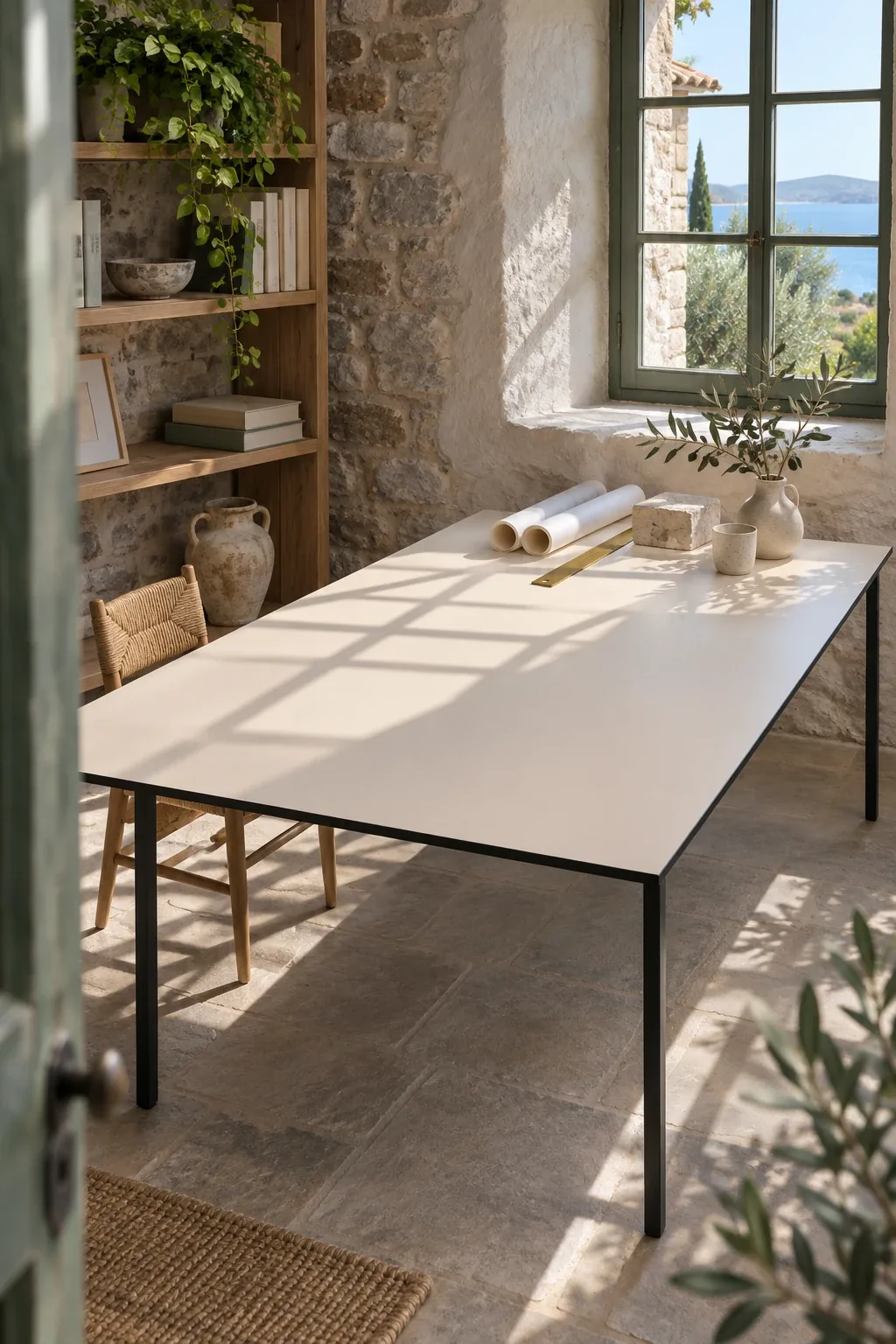
Short answer: We make compact laminate worktops (countertops in the US; also called solid laminate or compressed laminate worktops) from a single 12 mm panel as standard. If a thicker look is wanted, the panel does not get thicker; 12 mm strips are added along the edge (a 24 or 36 mm look), or a 50 mm apron is joined with a 45° miter. No edge banding is needed, and sink and tap cut-outs are machined on CNC.
Can you make a countertop from compact laminate, how thick is it, and how is the edge finished? Yes, you can; countertops are part of the work we do. As a Gentaş main dealer in Bornova, Izmir, we use G-COM compact laminate for countertops. Below we explain thickness, edges, cut-outs and everyday use in plain terms. We give no prices; at the end you will find what the price depends on.
Is a compact laminate countertop the same as a laminate countertop?
No. A "laminate countertop" usually means thin laminate (HPL) bonded onto a particleboard or MDF core. The surface is laminate, but the core carries the load, and the system weakens if the core and edges are left open to water. A compact laminate countertop has no core: the whole panel is the same material, it supports itself and both faces are decorative. We explain the difference in our guide to compact laminate vs. HPL.
Stone-based countertops such as marble, granite or quartz are a separate class of material. We do not compare against them here; we only describe what compact laminate offers.
How thick is a compact laminate countertop?
Our standard is 12 mm. We make the countertop from a single 12 mm compact laminate panel. For those who want it to look thicker, we apply the same logic as on our table tops: the panel does not get thicker, only the edge looks thicker.
| Edge look | How it is made | Seen from the side |
|---|
| 12 mm | Single panel. The edge is finished square, rounded or beveled. | One layer |
|---|
| 24 mm | One 12 mm strip is added underneath the 12 mm panel along the edge band only (12 + 12). | Two 12 mm layers with a thin black core line between them |
|---|
| 36 mm | Two 12 mm strips are stacked underneath along the edge band only (12 + 12 + 12). | Three 12 mm layers with thin black core lines between them |
|---|
| 50 mm | A vertical apron is made underneath along the edge and joined to the panel with a 45° miter. | An apron edge that reads as 50 mm |
|---|
So 24, 36 and 50 mm countertops are not one solid thick panel; the center stays 12 mm in every option. Knowing this up front makes both expectations and the quote clearer. The same build is shown with pictures on our compact table tops page.
How are the edges and corners finished?
Because compact laminate is the same material all the way through, no edge banding is applied. The edge is machined on CNC: it can be left square, rounded or cut with a 45° bevel. The black core of the compact shows at the edge; that is the natural look of the material. Corners can be left sharp or cut with a radius.
How are sink and tap cut-outs made?
We machine cut-outs in the workshop on CNC, not on site. For laboratory worktops we machine undermount or top-mount sink seats and tap and socket holes this way, and the method is the same for countertops. For that we need the size or model of the sink and tap. If you need another cut-out or a special detail, send the drawing and we will settle it in the quote. The cutting side is covered under CNC cutting services.
What should you keep in mind in everyday use?
Going by the values in the Gentaş G-COM datasheet:
- Water and moisture: compact laminate is resistant to water and moisture, and its surface is non-porous. That is why it is used in wet areas.
- Heat: in the 180 °C dry heat test (EN 438-2), the datasheet result is Level 4–5. That is a good value for short contact with hot items; even so, do not put a pot straight from the stove on the surface, use a trivet.
- Stains: stain resistance in the datasheet is Level 5. Wiping up spills promptly is enough.
- Scratches and wear: the surface is resistant to scratching and wear (abrasion 485 revolutions in the datasheet; the requirement is at least 350). It is not scratch-proof, so do your chopping on a cutting board.
- Location: G-COM is used both indoors and outdoors; tell us at the quote stage where it will be installed.
Where are compact laminate countertops used?
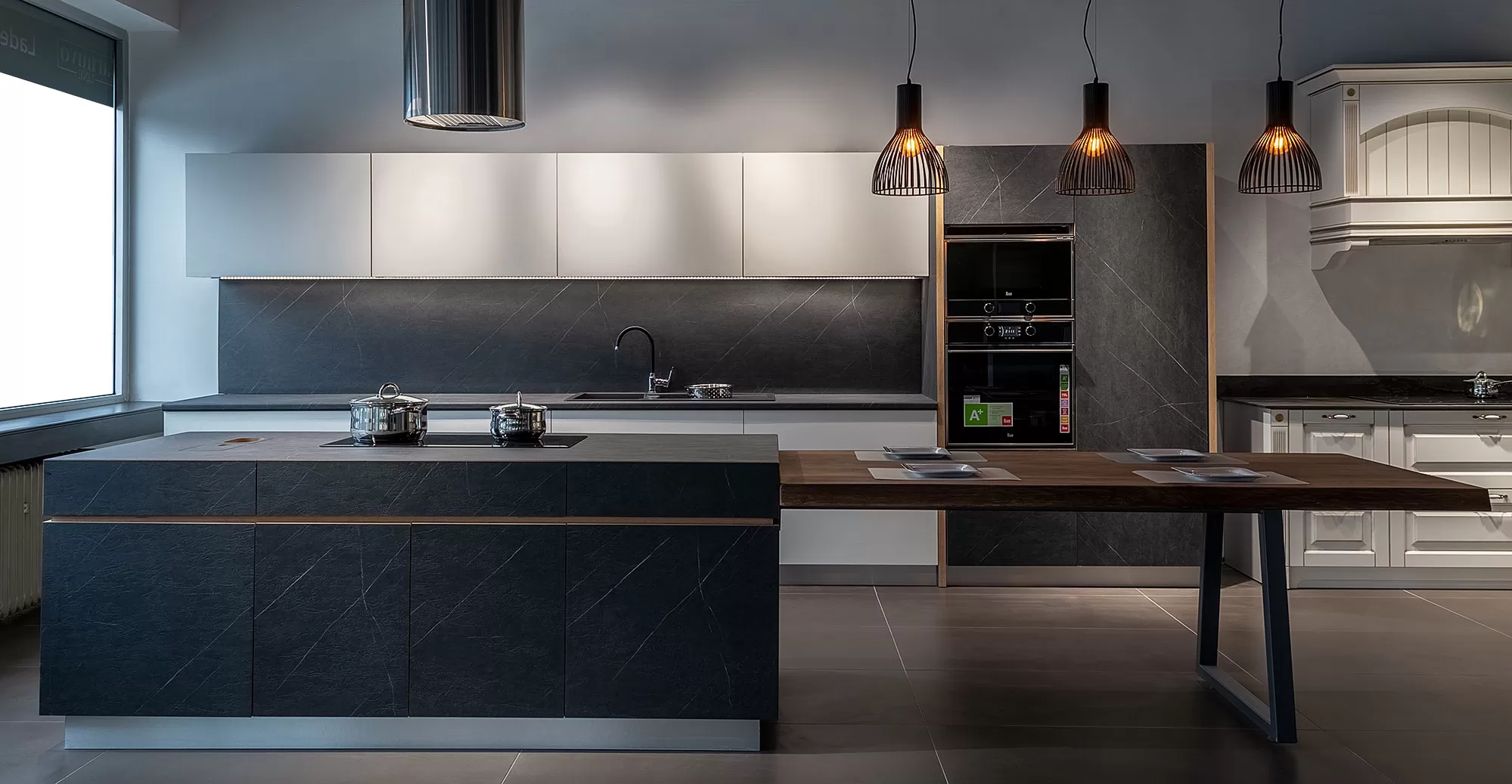
They are used for kitchen countertops and for work surfaces in workplaces. Laboratories that handle chemicals use a separate product, G-Lab, where worktop thickness is typically 12–20 mm. Technical values for the material are on the G-COM compact laminate page.
What does the price of a compact laminate countertop depend on?
We give no figures because every countertop is made to measure. The price depends on the length and depth, the edge look (12, 24, 36 or 50 mm), the decor, the number of cut-outs, the corner and edge work, and installation. For a quote, send us:
- Countertop dimensions (length × depth) and any L- or U-shaped returns
- The edge look you want: 12, 24, 36 or 50 mm
- Color code or decor
- Sink and tap size or model, plus any other cut-outs
- A drawing or hand sketch, and photos if possible
- Address and required date
Sending these over WhatsApp is enough; we settle the size and edge with you and prepare the quote.
Sources
Last updated: 2026-11
#compact laminate countertop
#compact laminate kitchen worktop
#laminate kitchen countertop
#solid phenolic countertop
#G-COM
#CNC cut-outs
 Panels & Plates
Manufacturer

 ®