Short answer: Gülmar does not make or sell doors; we supply door manufacturers with door-facing laminate. On interior doors, thin HPL or CPL laminate is bonded onto the door core. A toilet cubicle door is a 12 mm compact laminate panel. Exterior doors such as pivot doors use 6 mm G-EXT or G-EXT UV+.
Some people who search for laminate doors want a finished door; others make doors and are looking for the facing material. To be clear from the start: we are not a door maker. As a Gentaş main dealer in Bornova, Izmir, we supply the laminate used on the door face. Door manufacturers buy it from us especially for institutional work, large projects and special contracts. This guide explains which laminate suits which door.
What is the difference between HPL, CPL and compact laminate?
All three belong to the same family: decorative laminate made by pressing resin-impregnated paper layers under heat and pressure. They differ in thickness and in how they are used.
| Material | What it is | Thickness | Where on a door? |
|---|
| HPL | Thin decorative laminate pressed under high pressure. Not self-supporting; it is bonded to a core. | G-LAM: 0.30–1.20 mm | Interior door facing |
|---|
| CPL | Thin decorative laminate made on a continuous press line. Also bonded to a core. | G-LAM: 0.30–1.20 mm; widths 950 · 1240 · 1300 · 1400 mm | Interior door facing |
|---|
| Compact laminate | The thick, self-supporting form of the same build. Needs no core and is decorative on both faces. | G-COM: 2–25 mm | Toilet cubicle door (12 mm) |
|---|
| Exterior compact | Compact panel developed for sun and weather exposure. | G-EXT: 6 mm, 1300 × 3050 mm | Exterior door facing, such as pivot doors |
|---|
For a closer look at thin laminate versus compact, see our guide to compact laminate vs. HPL.
HPL or CPL for interior door facings?
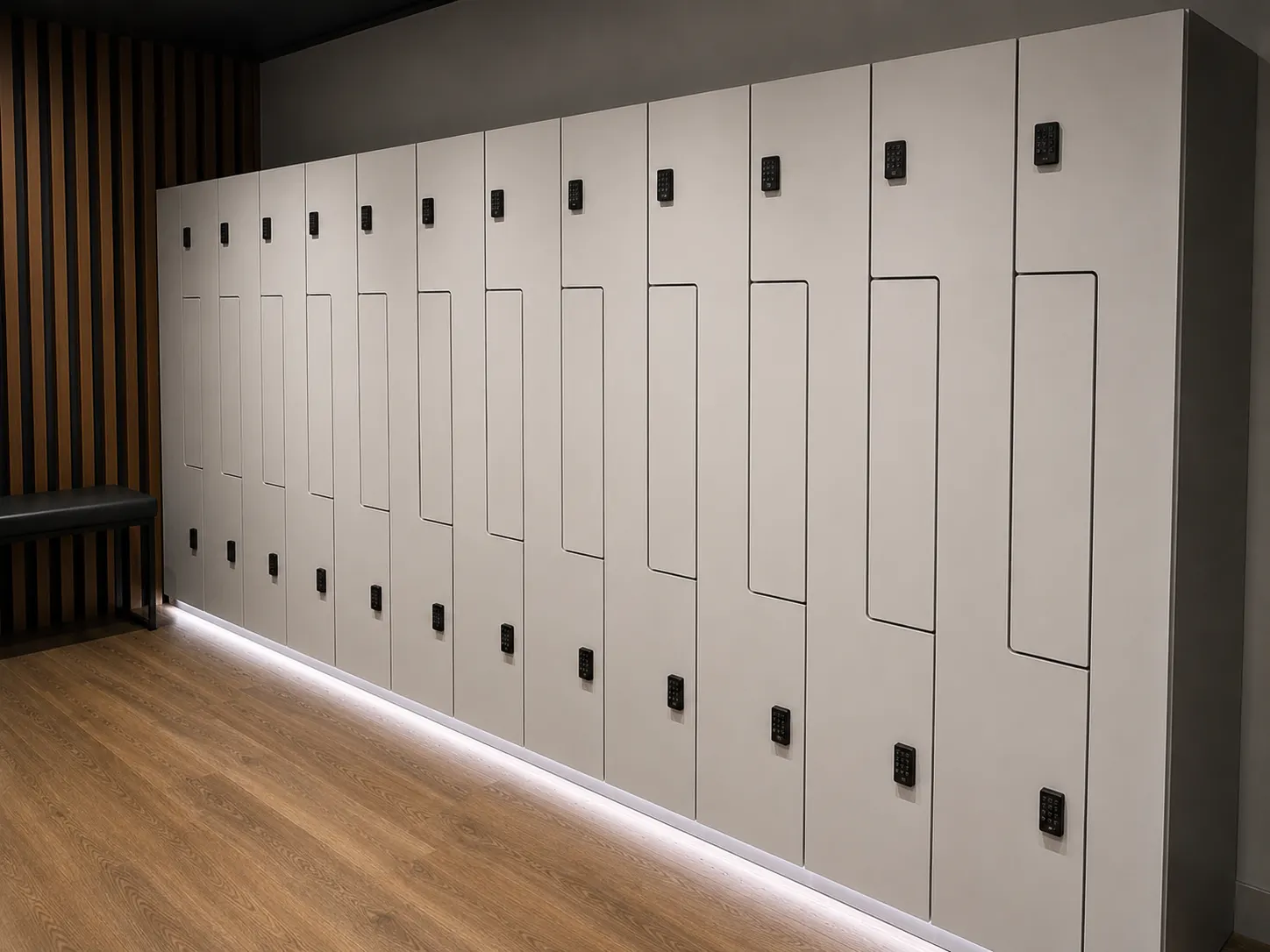
Both are used, and both are available in the Gentaş G-LAM range, which is produced on two separate lines, HPL and CPL. HPL comes in sheets, while CPL is supplied by width. The choice usually depends on the door maker's own press, the door size and the decor required. G-LAM's post-forming ability helps on curved edges, and it comes in more than 200 decors.
For profiled parts such as door frames and skirting, Gentaş's flexible laminate G-FLEX is a separate option. You can browse all decors on our colors and patterns page.
Our job here is to supply the laminate in the right decor, size and quantity. The door core, bonding and frame are the door manufacturer's work.
What is a compact laminate door?
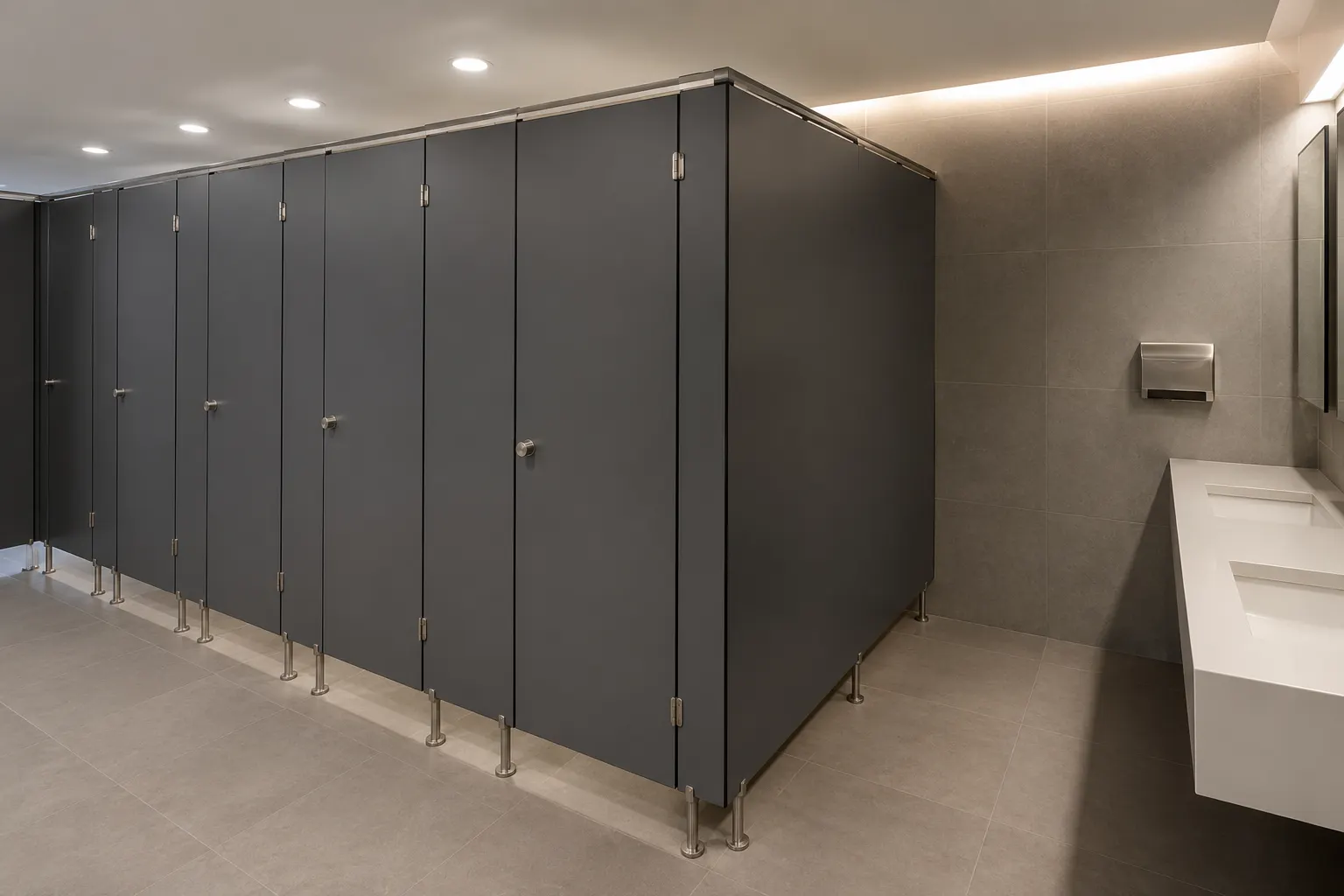
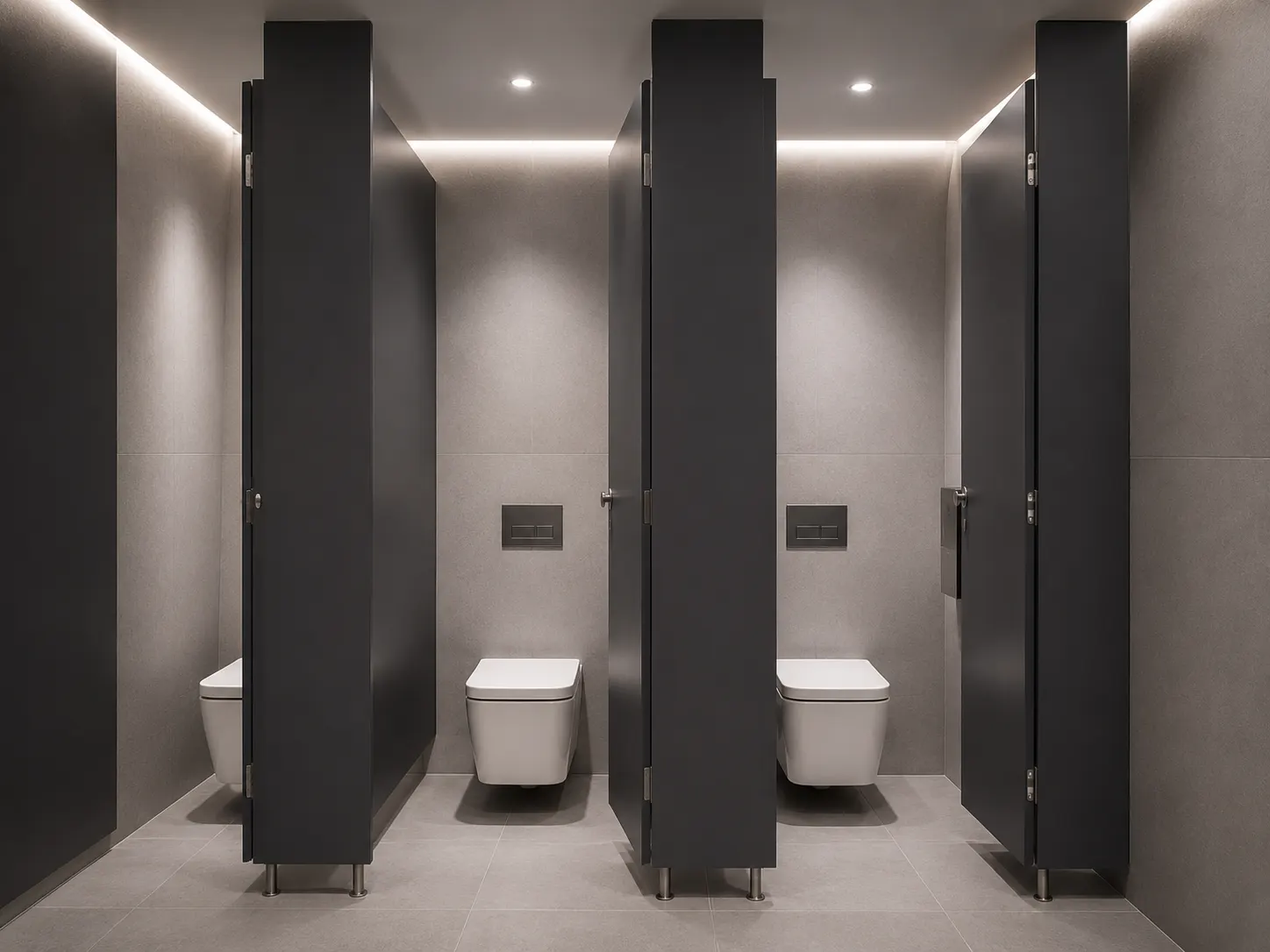
In most cases it means a toilet cubicle door. A cubicle door is not a cored door like a room door; it is the 12 mm compact laminate panel itself. Because compact laminate is the same material all the way through, it needs no edge banding; the edge is beveled or rounded. It is resistant to water and moisture, which is why it is chosen for wet areas.
We do not make room doors or entrance doors, but cubicle systems are our own work. In our WC cubicle systems, we cut the door, the partition and the front panel from the same 12 mm compact laminate and install them with their hardware. The material itself is on the G-COM compact laminate page.
Which laminate is used on exterior doors?
Interior laminate is not suitable for exterior doors; it is not designed for sun and rain. On doors that face the outside, such as pivot doors, the facing is 6 mm G-EXT or G-EXT UV+. G-EXT is produced to EN 438-6, the standard for exterior compact laminates, and the UV+ surface protects against fading. We supply G-EXT in 6 mm thickness and a 1300 × 3050 mm sheet size. Details are on the G-EXT facade panel page.
For large doors, sheet size should be discussed early: how does the door leaf fit on the sheet, and where will the joint fall? We settle this with you on the drawing. On request we prepare the panels to size with CNC cutting.
Is the laminate's fire class the same as the door's fire rating?
No, and the two should not be confused. A laminate is documented with a reaction-to-fire class (EN 13501-1): G-COM is B-s1,d0 at 12–25 mm, and G-EXT is B-s2,d0 (B-s1,d0 on request). For specifications that ask for fire-retardant laminate there is G-FIRE. How many minutes a door resists fire is a rating for the complete door (leaf, frame and hardware), and the door manufacturer obtains it. We provide the laminate's documents, not the door's.
What should a door manufacturer send for a quote?
- Door type: interior door, toilet cubicle door, exterior door (pivot, etc.)
- Laminate required: HPL, CPL, compact or G-EXT
- Color code or decor
- Door leaf sizes and quantity
- Full sheets or cut to size?
- Specification requirements (such as fire class)
- Delivery address and date
Send these over WhatsApp and we will work out the right laminate and quantity with you. The full product family is on the Gentaş laminate page.
Sources
Last updated: 2026-11
#laminate door facing
#HPL door
#CPL door
#compact laminate door
#toilet cubicle door
#G-EXT
#pivot door
#door skin laminate
 Panels & Plates
Manufacturer

 ®