Short answer: Under EN 438-4, any high-pressure laminate 2 mm thick or more counts as compact laminate. The application sets the thickness: according to ICDLI, compact sheets are usually self-supporting above 5 mm, and sheets over 8 mm suit large horizontal surfaces with more widely spaced supports. 12–13 mm is common for toilet cubicle panels, and Gülmar table tops are a single 12 mm sheet. In the G-COM data sheet, 12–25 mm is classed B-s1,d0.
There is no single right compact laminate thickness. Thickness changes more than stiffness: it also shifts the fire classification, the permitted flatness deviation, the support spacing you need and the weight your crew has to lift. Below, we have put the figures from the G-COM compact laminate data sheet into tables by thickness and matched each common application with a sourced recommendation.
What is compact laminate, and where does the thickness range start?
Compact laminate is a self-supporting high-pressure decorative laminate (HPL) with a thickness of 2 mm or more. Interior compact grades are classified in EN 438-4:2016 and exterior grades in EN 438-6:2016; both standards include “2 mm and greater” in their titles. Thin HPL needs a substrate, while compact sheets are used on their own. For the full comparison, see our guide on compact laminate vs. HPL.
What do CGS and CGF mean?
EN 438 grade codes are read letter by letter. The technical bulletin from ICDLI, the committee of European decorative laminate manufacturers, defines them as follows:
- C = Compact laminate
- G = General purpose (moderate use)
- S = Standard grade
- F = Flame-retardant grade
So CGS is a general-purpose standard compact and CGF a general-purpose flame-retardant compact. Gentaş lists G-COM under “CGS – CGF” with a TS EN 438-4 certificate; the fire table below shows the CGS values from the data sheet.
Does thickness change the fire class?
Yes. Different thicknesses of the same product can earn different EN 13501-1 classes. Here is the classification published in the Gentaş G-COM technical data sheet:
| Thickness (t) | EN 13501-1 class (G-COM, CGS) | Note |
|---|
| 3 mm ≤ t < 6 mm | D-s1,d0 | Data sheet |
|---|
| 6 mm ≤ t < 8 mm | D-s1,d0 | Data sheet |
|---|
| 8 mm ≤ t < 10 mm | C-s1,d0 | Data sheet |
|---|
| 10 mm ≤ t < 12 mm | No separate row in the data sheet | Confirm with test documents |
|---|
| 12 mm ≤ t < 25 mm | B-s1,d0 | Report no. ERA 19 036 |
|---|
The data sheet’s “required value” column shows the EN 438-4 minimum for CGS as D-s2,d0 or better. The ICDLI bulletin gives the same for CGS and “B-s2,d0 or C-s2,d0 or better” for CGF. Under the EN 13501-1 class definitions, a Class B product will not lead to flashover in the reference scenario but will contribute to a fully developed fire, while Classes C and D allow flashover later or earlier in the test. The “s” rating covers smoke (s1–s3) and the “d” rating flaming droplets and particles (d0–d2). For more, read what B-s1,d0 means for laminates.
One caveat: a classification applies to the mounting condition that was tested. If a spec calls for B-s1,d0, check thickness, mounting method and the scope of the test report together.
What flatness and thickness tolerances apply at each thickness?
Thinner sheets flex more, so the standard allows a larger flatness deviation at the thin end. These are the “required value” figures in the G-COM data sheet (EN 438-4 requirements, measured per EN 438-2 parts 5 and 9):
| Thickness (t) | Thickness tolerance | Flatness (max. deviation) |
|---|
| 2.0 ≤ t < 3.0 mm | ± 0.20 mm | 8 mm per 1 m |
|---|
| 3.0 ≤ t < 5.0 mm | ± 0.3 mm | 8 mm per 1 m |
|---|
| 5.0 ≤ t < 6.0 mm | ± 0.4 mm | 8 mm per 1 m |
|---|
| 6.0 ≤ t < 8.0 mm | ± 0.4 mm | 5 mm per 1 m |
|---|
| 8.0 ≤ t < 10.0 mm | ± 0.5 mm | 5 mm per 1 m |
|---|
| 10.0 ≤ t < 12.0 mm | ± 0.5 mm | 3 mm per 1 m |
|---|
| 12.0 ≤ t < 16.0 mm | ± 0.6 mm | 3 mm per 1 m |
|---|
| 16.0 ≤ t < 20.0 mm | ± 0.7 mm | 3 mm per 1 m |
|---|
| 20.0 ≤ t < 25.0 mm | ± 0.8 mm | 3 mm per 1 m |
|---|
| t ≥ 25.0 mm | Agreed between buyer and seller | 3 mm per 1 m |
|---|
On site, this means support spacing has to follow thickness. The ICDLI processing leaflet notes that the stability of cladding depends on both the substructure and the sheet thickness, and that sheets up to 5 mm need supports at shorter spacings, so a thin sheet over a wide span needs more supports. Compact laminate also changes dimension with humidity and temperature, so leave room for expansion: in the G-COM data sheet’s dimensional stability test at 70 °C (EN 438-2 part 17), sheets 5 mm and thicker changed by 0.18% lengthwise and 0.23% crosswise. The size of the gap depends on the fixing system.
How much does compact laminate weigh per square meter?
The G-COM data sheet reports a density of 1.4 g/cm³ (ISO 1183-1), against a requirement of at least 1.35 g/cm³. That gives a rule of thumb of thickness in mm × 1.4 = kg/m². The figures below are calculated approximations, not weighed values. The sheet column uses 1300 × 3050 mm (3.965 m²), one of the G-COM sheet sizes Gentaş lists.
| Thickness | Approx. weight (kg/m²) | 1300 × 3050 mm sheet (kg, approx.) |
|---|
| 6 mm | 8.4 | 33 |
|---|
| 8 mm | 11.2 | 44 |
|---|
| 10 mm | 14.0 | 56 |
|---|
| 12 mm | 16.8 | 67 |
|---|
| 13 mm | 18.2 | 72 |
|---|
| 18 mm | 25.2 | 100 |
|---|
| 20 mm | 28.0 | 111 |
|---|
| 25 mm | 35.0 | 139 |
|---|
At the minimum density of 1.35 g/cm³, the figures drop by about 3.5%. The ICDLI leaflet also calls for special care in transport and storage because of the weight: when loading and unloading, lift sheets one at a time rather than sliding them against each other. Weight also drives the choice of fasteners for wall cladding.
Which thickness fits which application?
The table below pairs the most common applications with sourced recommendations. Treat them as starting points; the project spec, spans and fixing details make the final call.
| Application | Typical / recommended thickness | Basis |
|---|
| Interior wall cladding | Set by support spacing; usually self-supporting above 5 mm | ICDLI processing leaflet |
|---|
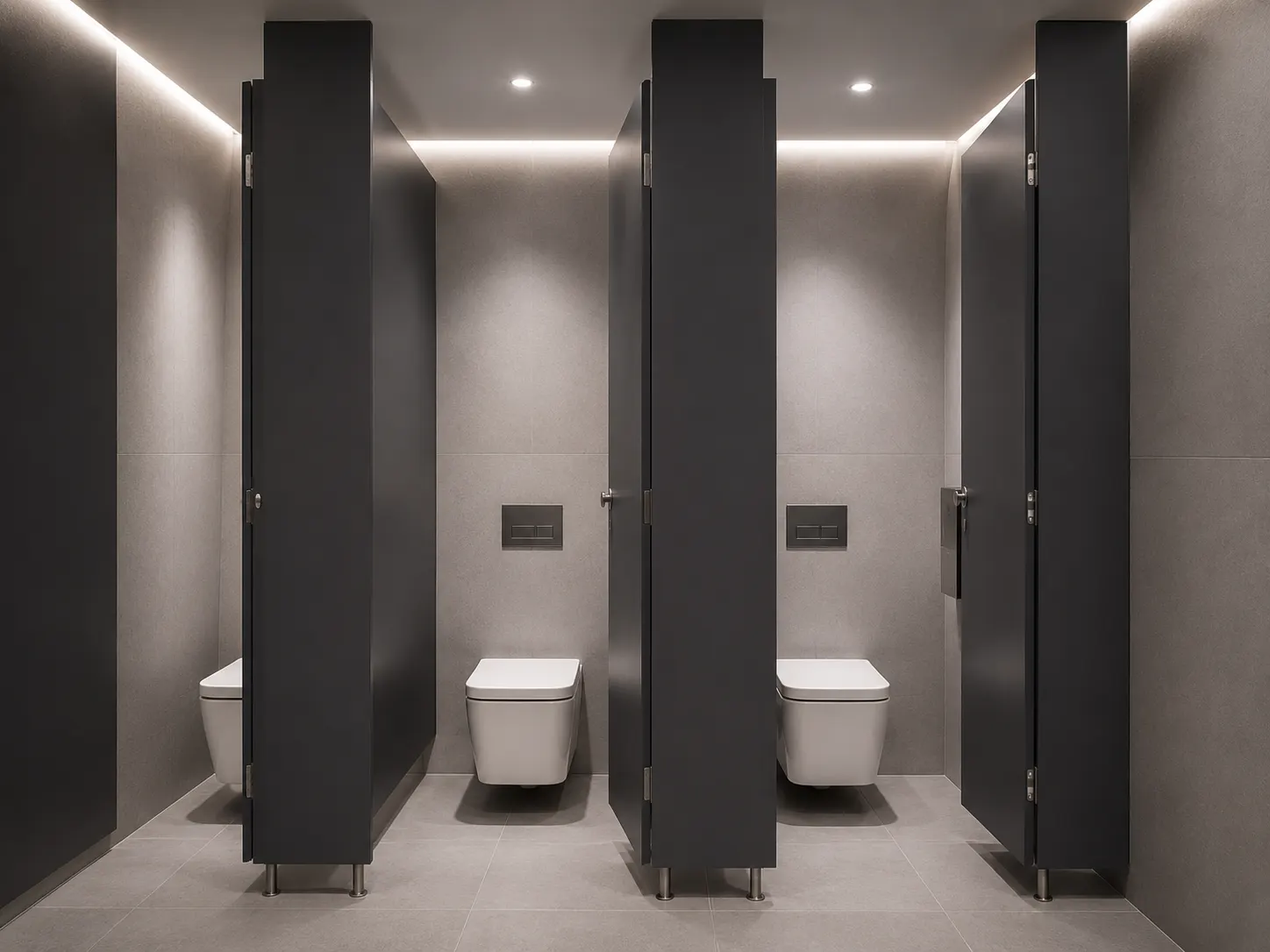
| Toilet cubicle partition panels | 12–13 mm is common | UFGS 10 21 13: phenolic panels at least 13 mm (½ in) |
|---|
| Cubicle doors and pilasters | 18 mm where loads or extra privacy call for it | UFGS 10 21 13: doors and pilasters at least 19 mm (¾ in) |
|---|
| Table tops | 12 mm single sheet at Gülmar | Gülmar practice; ICDLI: over 8 mm suits large horizontal surfaces |
|---|
| Exterior facades | EN 438-6 exterior compact (G-EXT: 6 mm) | EN 438-6:2016 |
|---|
- Wall cladding: support spacing, expected impact and any fire requirement set the thickness together. ICDLI calls for sufficient rear ventilation and room for the sheets to move, and in wet areas the panels should be kept clear of the floor.
- Toilet cubicles: 12–13 mm is common for partition panels. UFGS 10 21 13, the US unified facilities guide specification, asks for phenolic partition panels of at least 13 mm (½ in) and doors and pilasters of at least 19 mm (¾ in). See our WC cubicle systems page and the cubicle material guide.
- Table tops: ICDLI notes that sheets over 8 mm suit large horizontal surfaces with more widely spaced supports. At Gülmar, the top is always a single 12 mm sheet; a thicker edge look is built with 12 mm strips underneath (24/36 mm) or a 45° mitered apron (50 mm). See compact table tops.
- Lab worktops: span, load and chemical exposure set the thickness; see laboratory worktops and our chemical resistance guide.
Is there a real difference between 12 mm and 13 mm compact laminate?
The nominal difference is 1 mm and about 1.4 kg/m². Both fall in the same EN 438-4 tolerance band (12–16 mm, ± 0.6 mm), and both sit in the B-s1,d0 range of the G-COM fire table. 13 mm shows up often in inch-based specs because it is the metric equivalent of ½ in. The practical difference is hardware: hinges, feet and brackets are matched to panel thickness.
Why is the edge black, and does compact laminate need edge banding?
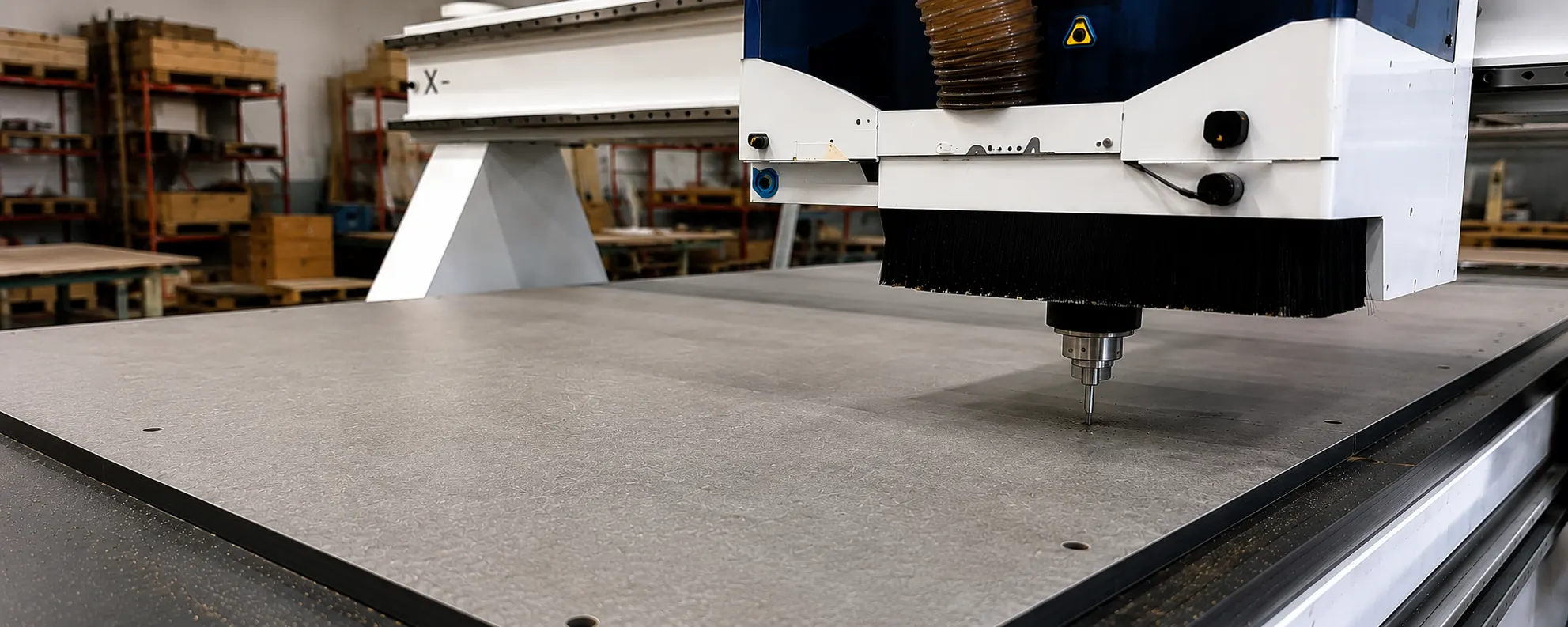
Compact laminate is the same material all the way through: layers of resin-impregnated cellulose with the decorative surface fused to the core. Standard grades have a black core; UFGS 10 21 13 lists “black core” and “color through the core” phenolic as separate options. No edge banding is needed: the edge is milled, chamfered or rounded. ICDLI’s processing leaflet says free-standing edges and corners should always be slightly rounded to avoid injuries, and suggests a silicone-free furniture oil to improve the look of a routed edge. Planning edge profiles and holes up front with CNC cutting to size gives the cleanest result.
Can the same compact laminate go on an exterior facade?
No. EN 438-4 covers interior compact laminate. Facades call for EN 438-6 exterior-grade compact, which is specified for sunlight, rain and frost. Gentaş classifies its exterior product, G-EXT UV+, to this standard. At Gülmar, the G-EXT exterior facade panel is supplied only in 6 mm thickness and a 1300 × 3050 mm sheet size. For facade design, see ventilated facades with G-EXT.
In what order should you decide on thickness?
- Environment: interior (EN 438-4) or exterior (EN 438-6)?
- Fire requirement: if the spec calls for B-s1,d0, the G-COM data sheet points to 12 mm or more; check the report scope against the mounting method.
- Span and supports: how far will the panel span, and what support spacing is planned?
- Fixings: ICDLI calls for at least 1.5 mm of material to remain below a blind hole, which limits screw depth in thin sheets.
- Weight and handling: factor sheet and panel weight into transport, installation and fastener selection.
How we work at Gülmar
Gülmar Yapı has been based in Bornova, İzmir since 1998 and has been a main dealer for Gentaş laminate products since 2020. We supply G-COM as full sheets or cut it to size in our own CNC shop, with holes, chamfers and edge finishing, and we install toilet cubicles, table tops and wall cladding. Typical CNC lead time is 7–10 days, and we have completed more than 1,200 projects. Send us your drawings or dimensions on WhatsApp and we will confirm the right thickness, stock availability and lead time in the quote.
Sources
Last updated: 2026-11
#compact laminate
#compact laminate thickness
#solid phenolic
#G-COM
#EN 438-4
#fire class
#toilet cubicles
#table tops
 Panels & Plates
Manufacturer

 ®